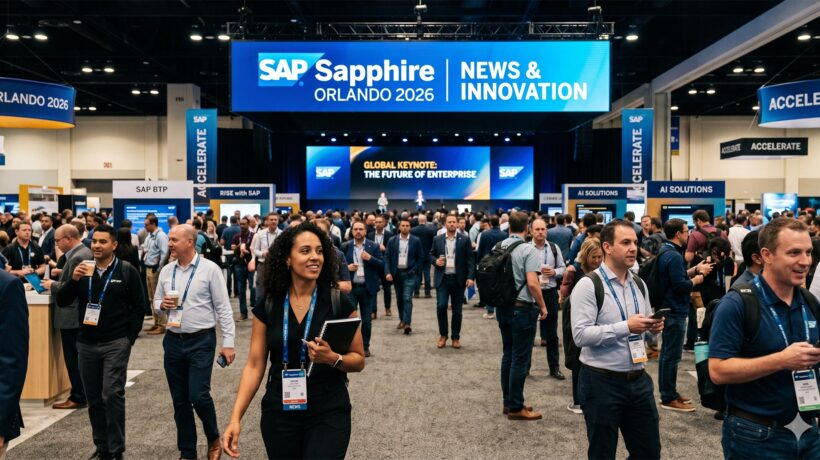



SAP Sapphire 2026 marked a significant shift in how SAP positions itself, not as a software vendor, but as a business AI company. CEO Christian Klein framed the central question of the event plainly: whether SAP will remain a software company at all. The answer, embedded in every major announcement, was the launch of the Autonomous Enterprise.
For enterprise leaders, this represents an architectural shift, not a feature update. The model is no longer AI that assists human decision-making; it is AI that executes mission-critical business processes independently.
The move to agentic AI
The defining announcement was the SAP Autonomous Suite. Where previous releases centered on copilots that surfaced recommendations, the 2026 release focuses on agents that act.
SAP has deployed 224 AI agents and 51 assistants across Finance, Supply Chain, HR, and Procurement. In the Finance track, the Autonomous Close Assistant handles journal entries, reconciliations, and error resolution without manual intervention, aiming to compress the month-end close from weeks to days.
Joule Work serves as the new interface layer for the SAP ecosystem. Rather than navigating Fiori screens, users interact through a natural language interface that coordinates multiple agents in the background to complete a defined business outcome.
The technical foundation
SAP has consolidated its underlying technology stack into the SAP Business AI Platform, unifying the Business Technology Platform (BTP), Business Data Cloud, and AI capabilities into a single governed environment.
The SAP Knowledge Graph is the most significant technical development from the event. It functions as a semantic map that provides AI agents with the business context needed to act accurately, understanding the relationships among assets, suppliers, and organizational structures, so agent decisions are grounded in real business logic rather than generic model outputs.
Joule Studio 2.0 provides the environment for enterprises and partners to build and govern custom agents. It supports a model-agnostic approach, with LLMs from Anthropic, Cohere, Mistral AI, and others available as the underlying reasoning layer.
Ecosystem and partnerships
SAP has structured the autonomous vision around an open, interoperable ecosystem. Key integrations include:
- Microsoft: bidirectional agent-to-agent integration between Microsoft 365 Copilot and Joule
- NVIDIA: compute infrastructure and the OpenShell runtime for secure agent execution
- Google Cloud: zero-copy data sharing and large-scale memory instances for global deployments
- Palantir: AI-supported data migration tooling to accelerate clean core adoption
Clean core migration
The autonomous enterprise model depends on a clean core, a cloud ERP environment free of legacy customizations. To address the migration barrier for on-premise customers, SAP announced agent-led migration.
AI is used to analyze legacy code and automate a significant portion of the migration effort. The practical implication is a reframing of AI value: rather than something realized after a cloud migration is complete, AI becomes the mechanism that makes migration viable.
What this means in practice
SAP is moving away from licensing software toward delivering measurable business outcomes. Autonomous agents in Finance and Supply Chain create direct, trackable value, whether that is optimizing cash flow or rerouting shipments during a disruption.
The real test will be governance. As agents operate across business functions and integrate with third-party platforms, the Agent Governance layer SAP introduced will determine how far enterprises are prepared to extend trust to autonomous systems handling sensitive data.