



Your organization ran SAP training before go-live. Attendance was solid. Most people passed the assessment. Six weeks later, the finance team is still calling IT for help posting basic invoices, the procurement team has rebuilt a parallel spreadsheet for purchase orders, and the go-live consultant contract has been extended for the third time.
This is not a technology failure. It is an SAP training ROI failure. And it is the norm, not the exception. A study by McKinsey and the University of Oxford found that large IT projects deliver 56% less value than predicted on average, with people and adoption issues among the primary causes. SAP implementations follow the same pattern.
SAP training ROI is not measured by attendance rates or assessment pass rates. It is a measure of whether users can run the business processes the system was built for, independently, at speed, without rebuilding capability through external consultants every time the team turns over.
This article explains why SAP training so often fails to deliver that return, how to properly measure SAP training ROI, and what a structured approach looks like in practice. If your program is still measuring completions and hoping for the best, this is where to start.
Why SAP training often fails to deliver ROI
Picture what typical SAP training looks like. Three weeks before go-live, a group of finance and procurement users sit through a two-day instructor-led session. The trainer covers the key transaction codes, process flows, and system navigation. Users take notes. They pass the final assessment. The training is logged as complete.
On day one post-go-live, those users are in the real production system for the first time. The configuration is slightly different from the training environment. The data looks unfamiliar. There is no instructor to ask. By mid-morning, the helpdesk is receiving calls. By the end of week one, the workarounds have started.
This pattern appears in SAP programs across industries and organization sizes. A study by McKinsey and the University of Oxford, covering more than 5,400 large-scale IT projects with initial budgets above $15 million, found that large IT projects run 45% over budget and 7% over time on average, while delivering 56% less value than predicted. People and adoption issues are consistently identified as primary failure factors across those projects. SAP programs are a clear illustration of that pattern.
Three failure modes explain most of it:
Training compressed too close to go-live
When end-user training is squeezed into the final two or three weeks before cutover, retention collapses. Users are anxious, distracted, and covering too much ground too fast. By go-live day, most of what was taught has already faded. They are not ready to work independently in a live system.
Generic content for role-specific work
A finance user posting supplier invoices and a procurement manager raising purchase orders are doing completely different jobs in the same system. Generic training covers both superficially and neither well. The result is users who are vaguely familiar with SAP but cannot handle the specific transactions required by their roles.
No baseline, no measurement
Without capturing capability before training and operational performance after go-live, there is no way to connect the training investment to business outcomes. You know people attended. You have no idea what changed. If you cannot measure it, you cannot manage it, and you cannot improve it.
What SAP training ROI actually means
SAP training ROI is the measurable business return from investing in structured capability development for people who design, implement, or operate SAP systems. It shows up as operational improvements: faster processing, fewer errors, reduced support tickets, higher adoption rates, and shorter time to full competency. It does not show up in satisfaction surveys or completion rates.
Most L&D and project teams measure training inputs: hours delivered, learners certified, modules completed. They assume a connection to business outcomes. That assumption is where the SAP training ROI disappears.
A user who passed a post-course assessment but is still relying on a spreadsheet for a process that should run in SAP has not gained capability. They have gained familiarity with content. That is different, and only one of them has business value.
There is also a cost that most organizations do not track: the ROI lost by ineffective training. That cost does not appear in a training budget. It shows up in post-go-live consultant extensions, helpdesk ticket volumes, mis-posted transactions that require manual correction, and delayed benefits realization.
For large SAP programs, practitioner analyses show that the hidden costs of inadequate user training and productivity loss during transition can far exceed the visible training budget, even though they rarely appear as a separate line item. The contrast between well-trained and poorly trained user populations becomes visible in the early post-go-live stabilization period, when organizations start to see differences in support demand, rework, and benefit realization.
| Dimension | Traditional SAP training | Capability-led SAP enablement |
|---|---|---|
| Core unit | Course or certification | Capability development system |
| Design question | “What courses do we need?” | “What must our teams be able to do?” |
| Learning path | Generic, role-agnostic | Role-specific, scenario-based |
| Measurement | Completion rates, pass rates | Adoption rates, error reduction, time to competency |
| Business alignment | L&D as project support | L&D as transformation enabler |
| Post go-live role | Training considered complete at cutover | Ongoing reinforcement and measurement |
What poor SAP training is actually costing you
The costs of inadequate SAP training are real. Most of them do not appear on a training budget line.
Rework and processing errors
When users do not understand the process behind the transaction, they make wrong postings. A supplier invoice coded to the wrong cost center needs manual correction. A goods receipt posted against the wrong purchase order creates reconciliation work downstream. Each error is small on its own. Across a finance team processing hundreds of transactions a month, the cumulative cost is significant, and it continues every month until the capability gap is closed.
Slow time to competency
The longer it takes users to reach full working proficiency, the longer the system operates below its designed capacity. Without structured, role-based training, users typically take considerably longer to work independently. That extended period is filled with helpdesk escalations, consultant calls, and process workarounds that often persist long after they should have stopped.
Consultant dependency that does not end
If your internal team cannot run SAP without external support six months after go-live, the project has not transferred capability. It has transferred the budget line to a different column. Unplanned consultant extensions are one of the most consistent financial consequences of poor SAP training. They are also one of the most avoidable.
Shadow systems and workarounds
When users find SAP too difficult to use confidently, they route around it. Spreadsheets, email chains, and manual logs re-emerge alongside the new system. The implementation delivers its full cost but a fraction of its designed value. And the longer shadow systems persist, the harder they are to remove.
How to measure SAP training ROI
If your current approach to measuring SAP training effectiveness starts and ends with completion rates, you are measuring the inputs to learning, not the outputs. Here is how to measure what actually matters.
Start with the right metrics
SAP training ROI requires connecting learning activity to operational outcomes. Choose your metrics before training begins. Establish a baseline. Measure the same indicators at 4, 8, and 12 weeks post-go-live.
| Metric | What does it tell you |
|---|---|
| Time to competency | How long before a user works independently without escalating to the helpdesk or a consultant |
| Error rate | Incorrect postings, rejected transactions, and manual corrections are required per user or per process |
| Support ticket volume | Helpdesk calls attributable to user error, tracked by transaction type and user group |
| Process cycle time | End-to-end time for key processes, for example purchase order to payment or goods receipt to invoice posting |
| Adoption rate | Percentage of users actively processing transactions in SAP as designed, not via workarounds |
| System utilization | Whether users are running the specific transactions their role requires, at the expected frequency |
These metrics exist in every SAP environment. Most organizations are already collecting them. The question is whether they are being used to evaluate training or only to monitor operations.
The baseline problem and how to fix it
The most common gap in SAP training measurement is not the metrics themselves. It is the absence of a pre-training baseline. If you do not know how long invoice processing takes before training, or how many posting errors occur in the first month post-go-live, you cannot demonstrate improvement. This is a planning failure, not a training failure. But it consistently makes training look immeasurable when it is not.
A Learning Needs Analysis (LNA) run before training design begins should produce this baseline. It assesses current capability by role, documents process performance where data exists, and sets the reference point for post-training measurement. If your program does not have one, that is the first gap to close.
Kirkpatrick and Phillips: measuring at the right level
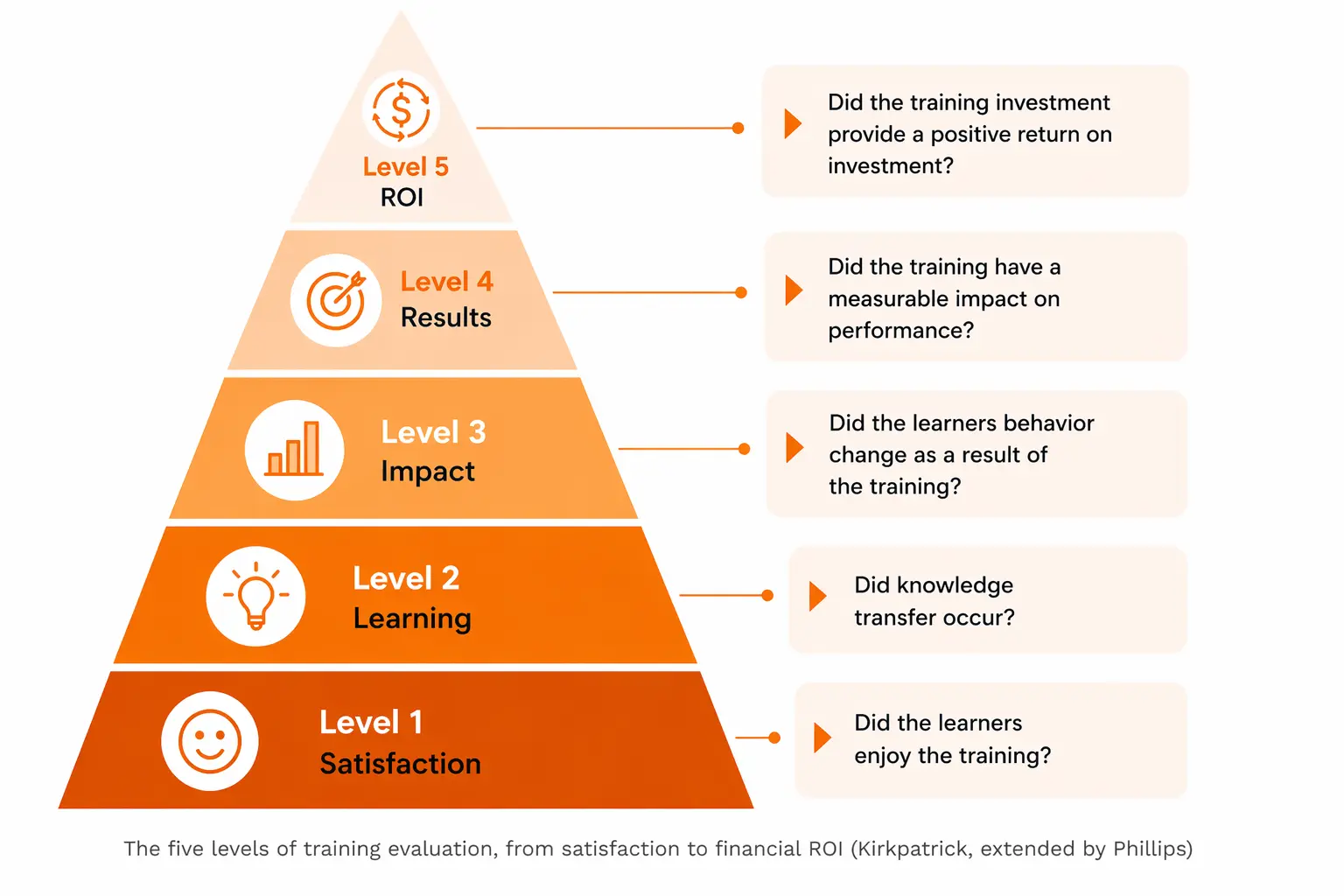
The Kirkpatrick Model is the standard framework for training evaluation, originally developed by Donald Kirkpatrick in 1959. Most SAP programs operate at Level 1 (satisfaction surveys) or Level 2 (assessment scores). They stop before reaching the levels where ROI becomes visible.
Level 3 measures behavior change: are users doing their jobs differently in SAP as a result of training? Level 4 measures business results: did those behavior changes produce measurable operational improvements?
The Phillips ROI Methodology adds a fifth level to this framework. Level 5 converts those business results into a financial ROI figure by comparing the monetary value of operational improvements with the fully loaded cost of the training program. For organizations making significant SAP enablement investments, Level 5 measurement provides the business case language that finance and executive sponsors respond to. It also reveals, with precision, where training investment is and is not delivering return.
A four-step framework for SAP training that builds real ROI
The difference between SAP training that delivers ROI and training that does not almost always comes down to whether it was designed around capability requirements or around a course catalog. Here is how to build the version that works.
Step 1: Run a Learning Needs Analysis before you design anything
A structured LNA maps your organization’s current SAP capability against what is required to deliver and operate the system effectively. It breaks this down by role (functional, technical, specialist) and identifies the specific gaps that training needs to close.
Without an LNA, training programs are guesswork dressed up as planning. With one, you know exactly who needs what, at what depth, and by when. A well-scoped LNA also reduces total training spend: instead of pushing everyone through a generic curriculum, you target investment where the gaps actually are.
Step 2: Build role-based, scenario-driven content
Effective SAP training is built around the processes users will run, not the system’s features. A purchase-to-pay module for a procurement team should walk users through the exact process steps they will perform in your organization’s specific configuration, using realistic data, in an environment that mirrors production.
When training is generic, it teaches the software. When it is role-based, it teaches the job. Only one of those produces capable users. The other produces users who recognize the system but cannot operate it confidently under live conditions.
Step 3: Build in hands-on practice before go-live
Retention from instructor-led or e-learning SAP training without a practice environment drops sharply within days of the session. Users who have not practiced real transactions in a sandbox before go-live are effectively learning on a live production system. Errors have real consequences. Anxiety is high. Confidence is low.
Hands-on training in a dedicated practice environment, close enough to go-live to be relevant but early enough to absorb feedback and reinforce learning, consistently outperforms classroom-only delivery. It is also where most training budgets take the shortcut, because the value is harder to demonstrate in advance than a cost line.
Step 4: Measure post-go-live and act on what you find
Training ROI is not confirmed at go-live. It is confirmed at 4, 8, and 12 weeks post-go-live, when you compare actual operational performance against your pre-training baseline.
If a user group is still generating high error rates on a specific transaction six weeks in, that is a training signal. Targeted reinforcement before poor habits set in is far cheaper than extended consultant support or rework. If your post-go-live review does not include training performance data, you are missing the signal.
What SAP training ROI looks like when it works
Organizations that invest in role-based, capability-focused SAP end-user training and in-app guidance typically see measurable post-go-live improvements in operational metrics within the first two to three months, including faster transaction processing, fewer user errors, reduced SAP support tickets, and quicker ramp-up to confident, independent use of the system.
The business case comes down to time-to-competency. The faster users operate independently in SAP, the sooner the system delivers value. Each additional week of dependency on support teams, workarounds, or external consultants delays ROI and increases cost. Organizations that invest in structured, role-based enablement consistently report shorter time to competency and improved productivity compared to generic training approaches, though specific figures vary by program design, organization size, and configuration complexity.
Where training is treated as a pre-go-live checkbox, the picture is different. Manual corrections persist for months, not weeks. Helpdesk demand stays elevated. Benefits realization is delayed. In some cases, teams partially revert to legacy processes. The training cost appears to have been saved. The program cost shows up everywhere else.
Building the internal case for SAP training investment
Most SAP training investment decisions are made within a constrained project budget. The default framing is: training is a cost. Can we reduce it? The right framing is: SAP training directly affects the ROI of the entire initiative. Can we afford to reduce it?
For sponsors and finance teams, the language that lands is Phillips Level 5: what is the fully loaded cost of the training investment, and what is the monetary value of the operational improvement it produces? That calculation, done properly, almost always returns a strong positive. It also shows which components of the training effort drive the most return and where investment should be focused.
For L&D leaders, the framing that shifts the conversation is this: if post-go-live performance data shows capability gaps, those gaps have a cost. Every week of extended consultant support, every manual correction, every process workaround is measurable. The LNA and training should be presented alongside that cost, not as a separate line item.
Frequently asked questions
What is SAP training ROI?
SAP training ROI is the measurable business return from investing in structured capability development for people who use or implement SAP systems. It shows up in operational improvements: error reduction, faster processing times, lower support costs, and shorter time to competency. Completion rates and satisfaction scores do not measure it.
How do you calculate ROI from SAP training?
Use the Phillips ROI Methodology. Establish a baseline of key operational metrics before training begins. Measure the same metrics at 4, 8, and 12 weeks post-go-live. Convert the performance improvement to monetary value (time saved, errors avoided, consultant costs not incurred). Compare that value against the fully loaded cost of the training program. That is your SAP training ROI.
Why do SAP implementations often fail to deliver projected ROI?
A 2012 study by McKinsey and the University of Oxford, covering more than 5,400 large IT projects, found that large projects run 45% over budget and deliver 56% less value than predicted on average, with people and adoption issues as primary contributing factors. Training gaps are a consistent factor in these outcomes: when users cannot run business processes confidently and independently, the system operates below its designed capacity regardless of how well it was technically implemented.
How long does it take to see ROI from SAP training?
Organizations with structured, role-based SAP training programs typically see measurable improvement in operational metrics within 4 to 8 weeks of go-live. The main indicators are reduced helpdesk escalations, lower processing error rates, and users reaching independent competency earlier. Unstructured or generic training extends all of these timelines significantly, sometimes by months.
What is the Phillips ROI Methodology and how does it apply to SAP training?
The Phillips ROI Methodology extends the Kirkpatrick four-level evaluation model with a fifth level: financial ROI. Level 5 converts the operational improvements produced by training into a monetary value, then compares that value against the fully loaded training cost to produce an ROI percentage. For SAP enablement programs with significant investment, Level 5 measurement provides the business case evidence that finance and program sponsors respond to. It also isolates where training investment is and is not producing return.
What is a Learning Needs Analysis in the context of SAP?
A Learning Needs Analysis (LNA) is a structured assessment of current SAP capability against the skills required to deliver and operate the system effectively. It identifies gaps by role, functional area, and project phase. An LNA also establishes the pre-training baseline needed for post-go-live ROI measurement. In a well-run SAP program, the LNA precedes training design and ensures that investment is targeted at actual capability gaps, not assumed ones.
What metrics should I use to measure SAP training effectiveness?
Use operational metrics, not training-specific ones. Time to competency (how quickly users work independently), error rate (incorrect postings, rejected transactions), support ticket volume, process cycle time, and system adoption rate all reflect whether training produced real capability. Satisfaction scores and completion certificates tell you the training was delivered. They do not tell you whether it changed how people work.
Should all SAP users receive the same training?
No. A finance user posting invoices, a procurement manager raising purchase orders, a functional consultant configuring the system, and a Basis administrator managing the technical environment all need fundamentally different training. Generic programs cover all of these superficially and none of them well. Role-based training paths that reflect specific process responsibilities and real delivery scenarios produce job-ready users. Generic programs produce users who are familiar with the system but not equipped to work in it under live conditions.
Build the SAP capability your program requires
SAP training ROI does not come from running training. It comes from building the capability to work with the system effectively, in the right roles, at the right depth, before and after go-live.
Organizations that see strong returns treat their SAP enablement program as a capability system. They run a Learning Needs Analysis before design, build role-specific scenario-based content, include hands-on practice before go-live, and measure against operational benchmarks post-go-live. They use the Kirkpatrick Model to evaluate behavior change and business results, and the Phillips ROI Methodology to convert those results into the financial language their business requires.
Organizations that treat training as a pre-go-live checkbox see a different outcome: slower adoption, higher support costs, and a persistent gap between what the system should deliver and what it actually does.
If your SAP program is approaching a key milestone and training is still a line item rather than a strategy, start with a Learning Needs Analysis. It will tell you where the gaps are, what it will cost to close them, and what it costs to leave them open.
Understand your current SAP capability gaps
Delivery risk on SAP projects is rarely a technology problem. It is a capability problem, and most organizations do not identify it until a project has already stalled.
K2 University works with enterprise teams to assess capability gaps and build SAP enablement programs aligned to real delivery requirements.
Sources
All URLs verified March 2026.
- McKinsey & Company / University of Oxford (2012), Delivering large-scale IT projects on time, on budget, and on value
- Kirkpatrick Partners, The Kirkpatrick Model (official site)
- ROI Institute, Jack J. Phillips, ROI Methodology (official site)
- Panorama Consulting Group (2025/2026 ERP Reports), ERP Report, Panorama Consulting Group
- Mind Tools, Kirkpatrick Model overview, Kirkpatrick’s Four-Level Training Evaluation Model
- Training Industry, Kirkpatrick Model, The Kirkpatrick Model
- Whatfix, Phillips ROI Model explained, Phillips ROI Model: The 5 Levels of Training Evaluation